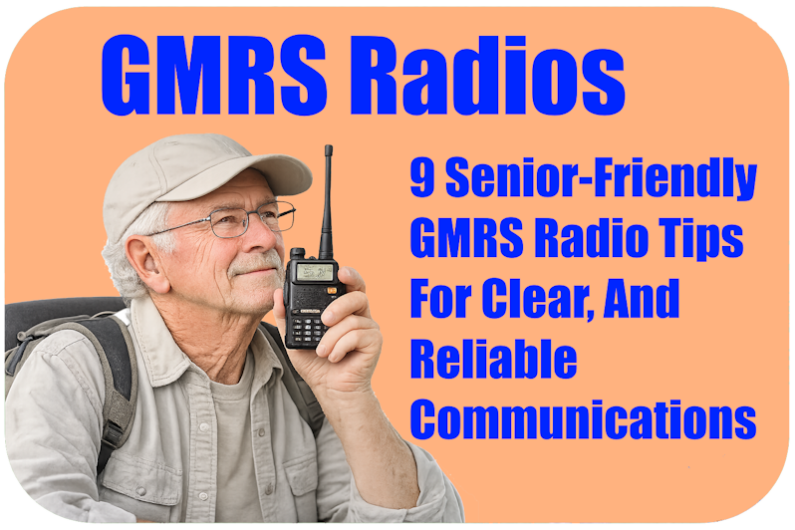
Worried about emergency communications? Or just a simple way to keep in touch with your neighborhood watch or family? We have the answer for you.
If you’re a senior looking for a simple, reliable way to stay in touch with family, travel companions, neighbors, or emergency contacts, a GMRS Radio might be one of the best tools you’ve never used. I’ve been operating GMRS radios for years—on road trips, during storms, camping trips, and even keeping in touch with family, and I can tell you this:
GMRS radios are practical, affordable, and much easier to use than most people expect.
This short guide will walk you through:
- Why Do I Need A GMRS Radio
- What a GMRS radio is
- GMRS Radio Frequencies (in plain English)
- How To Get Your GMRS License
- GMRS Regulations And Operating Tips
- What Kind Of Radio Do I Need For GMRS
- Programming Your Baofeng UV-5G GMRS radio
- GMRS Best Practices (Operator Tips)
- Why GMRS Radios Are An Excellent for Seniors
So let’s get started.
Why Do I Need A GMRS Radio
Sure, everybody has a cell phone these days, but here are practical reasons many people choose to own a GMRS radio, especially families, seniors, and anyone who values reliable communication:
- Works when cell phones fail – No towers or internet needed, so it’s dependable during power outages, storms, and disasters.
- Instant communication – Press one button and talk; no dialing, apps, or waiting.
- Better range than walkie-talkies – GMRS radios reach farther and can use repeaters for even more distance.
- One license covers your whole family – Everyone can communicate on the same system legally.
- Great for emergencies – Used for neighborhood coordination, weather events, and safety checks.
- Simple to use – Large buttons, clear audio, and easy controls make it senior-friendly.
- No monthly fees – Buy the radio once and use it for years.
- Perfect for travel and outdoor use – RV trips, camping, road caravans, and remote areas.
- Reliable backup to modern technology – A proven communication method that works even when modern systems don’t.
- Peace of mind – Knowing you can reach someone when it matters most.
- It’s FUN!
Using a GMRS radio isn’t just about emergencies and safety — it’s also a lot of fun, and surprisingly social. One of the best parts is the friendly conversations you naturally fall into with other local operators like the HAM and CB operators. You start recognizing voices, learning who lives nearby, and building a small community over the air. It’s common to chat about the weather, road conditions, gardening, RV trips, or just how everyone’s day is going.
For many seniors, it becomes a pleasant routine — turning on the radio in the morning or evening to see who’s around. In short, a GMRS radio gives you conversation, community, and connection — along with safety. It turns simple communication into a shared hobby that’s easy to learn, relaxing to use, and genuinely enjoyable. Join a local GMRS or amature radio club and make new friends
The 30 Day Emergency Prepping Plan for Seniors: A Friendly Guide.
What Is a GMRS Radio?
GMRS stands for General Mobile Radio Service. It’s a two-way radio system approved by the FCC (Federal Communications Commission) for personal and family communication.
A GMRS Radio is commonly used for:
- Family communication during trips
- RV travel and caravans
- Neighborhood emergency preparedness
- Outdoor activities (camping, fishing, hiking)
- Backup communication during power outages
Unlike cell phones, GMRS radios:
- Do not rely on cell towers
- Work during blackouts
- Are simple to operate
- Provide instant communication
When an emergency happens, one of the first things that often fails is communication. Power goes out. Internet disappears. And cell towers go down. Your GMRS radio will keep on working. That alone makes it one of the most valuable emergency tools you can own. For seniors, that last point is important: press a button and talk—no apps, no passwords, no internet required.
Understanding GMRS Radio Frequencies (Without the Technical Headache)
Every radio system works on specific frequencies. Think of frequencies as “lanes on a highway” that your radio uses to talk and listen.
GMRS frequencies operate in the UHF range between 462 and 467 MHz and are divided into channels used for short-range direct communication and longer-range repeater use. These frequencies are well suited for clear voice communication in neighborhoods, towns, and outdoor areas because they handle buildings and terrain better than lower-frequency radios. By using designated GMRS channels, users can communicate reliably while minimizing interference with other radio services.Common GMRS Channels
| Channel Type | Frequency Range | Purpose |
| Simplex Channels | 462.xxx MHz | Radio-to-radio direct communication |
| Repeater Input | 467.xxx MHz | Sending signal to a repeater |
| Repeater Output | 462.xxx MHz | Receiving boosted signal |
What This Means for You
- Simplex = radio talks directly to radio
- Repeater = radio talks to a tower that rebroadcasts your signal much farther
You don’t have to use repeaters, but they are extremely useful for emergency communication. Repeaters are what allow GMRS radios to reach across towns, over mountains and can boost your range 20–50+ miles in some areas. Think of it like this:
- No repeater = talking across a neighborhood or a few miles
- With repeater = talking across a city or even counties
Many people never use repeaters at all—and that’s perfectly normal.
Do I Need a License for a GMRS Radio?
The simple answer is Yes!—GMRS Radios are not CBs. You need a GMRS license because it allows you to legally transmit on GMRS radio frequencies and use higher power and repeaters.
Why Licensing Matters
- Keeps frequencies organized
- Reduces interference
- Allows repeater access
- Makes emergency communication reliable
As an operator, I strongly recommend licensing—it protects you and improves everyone’s experience. But relax, it’s super easy to get your GMRS license. It’s also pretty inexpensive at $35 for the license. It requires no test, no exam, no special skills. Your GMRS license is good for 10 years, and covers your entire family, making it simple and affordable. It is, however, a multi-step process
- Go to fcc.gov
- Create a free FCC account (called a CORES account) You’ll need to register and get your 10 digit FCC Registration Number (FRN). You get this at the FCC Registration page
- Apply for a GMRS license. You can visit the AZGMRS.org “get a GMRS license” page, and it will help walk you through the entire licensing process.
- Pay the fee (currently around $35)
That’s it! You’re done. You are now legally authorized to use a GMRS radio. You should receive your GMRS radio license in the next 24-48 hours
Don’t forget, you can share your GMRS license with your immediate family. A single 10-year GMRS license covers the holder and all immediate family members, regardless of age, allowing them to operate radio stations under your call sign. Immediate family includes spouses, children, parents, grandparents, aunts, uncles, nieces, nephews, and in-laws.
Key Details on Sharing GMRS Licenses:
- Definition of Family: The FCC defines immediate family broadly, including spouses, children, parents, grandparents, siblings, aunts, uncles, nieces, nephews, and in-laws.
- No Age Restriction: While the licensee must be 18+ to apply, family members of any age can use the radios under that license.
- Call Signs: All family members must use the main licensee’s call sign to identify themselves, usually every 15 minutes and at the end of transmissions.
- Optional Unit Numbers: To distinguish between users (e.g., “This is WXYZ123, unit 2”), users can optionally append a number to the main call sign.
- Emergencies: Anyone may use a GMRS station to communicate an emergency message.
There are limitations to your GMRS license. For example: Non-Family: The license does not cover friends, neighbors, or extended relatives not listed in the immediate family definition. GMRS is for individual/personal, non-commercial use. And Resident Requirements: While some interpretations suggest “household” members, official rules focus on the “immediate family” definition rather than strict cohabitation, though they typically operate within reasonable range of each other.
GMRS Regulations And Operating Tips
Yep! Like anything free and cheap, it comes with a catch. GMRS radios are regulated, and you should familiarize yourself with the rules of using a GMRS radio.
You can find the official GMRS regulations and helpfull tips from these trusted sources:
FCC (Federal Communications Commission) – Primary Source
The full rules are in FCC Part 95, Subpart E (GMRS).
FCC GMRS Service Page (Beginner-friendly)
Explains licensing, permitted use, power limits, and channels.
The link is: FCC GMRS service
ARRL (American Radio Relay League)
Provides plain-English explanations of GMRS and amateur radio rules.
The link is: https://www.arrl.org/home
MyGMRS.com (Community resource)
Practical explanations, repeater info, and operating tips based on FCC rules.
What Kind Of Radio Do I Need For GMRS
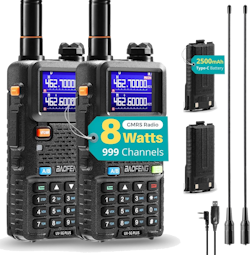
If you’ve searched for GMRS radios online, you’ve probably seen the Baofeng UV-5G. It’s one of the most popular and affordable handheld radios in the world. You can easily keep one each in your home and, one in each of your vehicles. I’m a huge fan of Baofeng radios owning both the Baofeng UV-5G (for GMRS) and the Baofeng UV-5R (for HAM)
Let’s talk about the Baofeng UV-5G a bit. This is a handheld GMRS radio based on the classic Baofeng UV-5R design, but specifically configured for GMRS frequencies. It’s built to be ready to use right out of the box for GMRS communication when you have your FCC GMRS license. You can buy these in a single (approximately $35 each) or two pack. (approximately $65 for a pair) It’s hard to beat the cost of these.
Why Is The Baofeng UV-5G So Popular
- GMRS-Ready: Unlike the standard UV-5R (which is a ham radio and not legally allowed on GMRS without modification), the UV-5G is designed to operate on GMRS frequencies approved under FCC Part 95.
- Simple Setup: It’s pre-programmed with GMRS channels, NOAA weather channels, and often comes with features like channel scanning, dual watch, and tone codes.
- Affordable Choice: One of the most budget-friendly handheld radios for personal or family GMRS use.
Key Features of the Baofeng UV-5G
Here’s what you can typically expect from the UV-5G family of radios:
- FM Two-Way Communication: Listen and talk on designated GMRS channels.
- Pre-Programmed GMRS Channels: Ready-to-use GMRS talk and repeater channels. It has up to 969 programmable channels.
- NOAA Weather Reception: Built-in ability to receive weather broadcast channels.
- Channel Scanning & Dual Watch: Helps you monitor two channels at once.
- Rechargeable Battery & Portable Handheld Form Factor: Great for outdoor use and emergencies.
- Lots of accessories like extended batteries, external speaker/mic, and tactical antennas
Some versions, like the UV-5G Plus add a color display, frequency copy capability, and a USB-C rechargeable battery, making them even easier to use.
I’ve set these up for several Baofeng’s. They’re easy to configure, and within minutes, you can be chatting comfortably.
Baofeng UV-5G Radio Range: What You Can Really Expect
Alright, since we’re talking about a handheld radio, let’s talk honestly about radio range. Hand-held radio manufacturers often claim “Up to 30 miles!” and that may be true if you are for example on a boat out in the open ocean talking to another boat 15-30 miles away. Truth is land-based radios have some things to consider when it comes to comms distance.
The actual distance you can transmit depends on several factors such as terrain. Hills, trees, and buildings block UHF signals easily. Your antenna quality matters. A better antenna can noticeably improve range. Don’t forget about elevation. Radios held near the ground have less range than those positioned higher up. And lastly, there are the obstructions between your radio and the person your talking to. Inside cars, homes, walls, or dense forests can cut your radios range dramatically. Even your battery strength and the weather can affect your radios range.
Here are your real-world Radio Range limits
- Everyday use: 1–3 miles handheld-to-handheld
- Good conditions: 3–7+ miles
- Line-of-sight or high ground: 10+ miles
- With repeater: 20+ miles possible
To get optimum range & performance for your radios is to:
- Upgrade the antenna
- Use higher ground
- Use a repeater
- Keep batteries charged
- Avoid indoor use when possible
Programming your Baofeng UV-5G GMRS radio
You are probably going to want to program your radio. On mine I have the GMRS channels, but I like to add in weather and local search and rescue channels for when I’m doing outdoorsy things and since I live here in southern Arizona, I also include our local Arizona Border Patrol channels. The hot summers here in Arizona can kill border crossers, and you never know when a trip to one of our border lakes to go fishing just might turn into a humanitarian rescue mission.
The best tool you have to program your radios is a free software tool called CHIRP. You can download it at https://chirpmyradio.com/projects/chirp/wiki/Download. You will also want to pay attention to their help guides at https://chirpmyradio.com/projects/chirp/wiki/Documentation.
The next thing that you need is a data cable. You should get one with your new radio. If not, be sure you order the correct cable for your radio model. Be aware that a generic data cables may not be compatible with CHIRP.
Now let’s talk about CHIRP. The beauty of using CHIRP is that it allows you export/import your data from a .csv file. It’s a spreadsheet file that you can easily edit using Microsoft Excel or Google Sheets. The first thing we want to do is download your radio’s base image. We do this just in case we want to restore the radio to factory default. Next, is to export our radio’s settings into a .csv file. Once that is done, make a copy of that csv file that you can edit with your custom frequencies. Save the file, and you can import it to your radio. That’s it!

Easy-peasy right? Make sure you save that default image file and your original and modifed .csv files in a safe place in case you need to restore your settings or make changes to your programming later.
Here are a couple PDF guides that you can download to help you navigate using CHIRP
- http://www.k7csw.org/wordpress/resources/?drawer=CHIRP
- https://noji.com/hamradio/pdf-ppt/noji/Noji-Article-CHIRP.pdf
- https://n7tar.org/wp-content/uploads/2025/10/2025-10-11-Programming-your-radio-using-a-computer.pdf
GMRS Best Practices (Operator Tips)
Here are habits good operators follow:
- Identify with your call sign occasionally
- Keep transmissions short and clear
- Listen before talking
- Avoid profanity
- Use emergency channels only for emergencies
- Recharge batteries weekly
These simple steps keep the system friendly and effective.
Why GMRS Radios Are An Excellent Choice for Seniors
From one operator to another, future operator, A GMRS radio gives senior citizens a simple, dependable way to stay connected when it matters most. Unlike cell phones, GMRS radios do not rely on the internet or cell towers, so they continue working during power outages, storms, and emergencies. With one-button operation, clear audio, and no complicated menus, they are easy to learn and comfortable to use, even for those who are not tech-savvy. One affordable license also covers the whole family, making it easy for children and grandchildren to stay in touch during trips or emergencies.
In summary, a GMRS radio offers seniors a powerful blend of simplicity, safety, and connection that modern technology often fails to provide during critical moments. From easy one-button operation and dependable performance during power outages to affordable family licensing and useful real-world range, GMRS radios deliver reliable communication without monthly fees or technical complexity. Whether used for emergencies, travel, neighborhood coordination, or friendly daily conversations, a GMRS radio empowers seniors to stay informed, independent, and confidently connected to the people and communities that matter most.
Key takeaways:
- Reliable communication even when cell phones and internet fail
- Simple, senior-friendly operation with no technical learning curve
- One low-cost license covers the entire family for 10 years
- Useful range for neighborhoods, travel, and emergencies (even more with repeaters)
- Adds safety, peace of mind, and enjoyable social interaction
Want more practical, experience-backed articles like this? Subscribe to our newsletter today and get expert senior-focused tips, strategies, website updates, announcements and product recommendations delivered straight to your inbox.